
How to Use a Shower Ball: Lather Lightly, Rinse, Dry Outside
Make lather with body wash, rub lightly, then rinse, squeeze out the water and dry it outside the bathroom. Replacement times differ by source, so Haneul lined them up in a table.


Make lather with body wash, rub lightly, then rinse, squeeze out the water, and dry it outside the bathroom. That is the whole method for using a shower ball. What changes over long use is the drying.
It is easy to think the mesh cleans better, and that you have to scrub hard to feel clean. But a Cleveland Clinic dermatologist says the opposite: use less force, and let it dry after use. That advice was about loofahs, both natural ones made from dried tropical gourds and plastic, synthetic ones. Korea’s Health Chosun reported the same advice in an article about shower balls.
You know the days when you hang it up after a shower and think, ‘When did I last change this?’ This guide covers the order of use, places to avoid, drying, washing, when to replace it, and what to look for when you buy. Using a scrub towel is covered in the scrub towel guide, and grain scrubs in the body scrub guide.


How do you use a shower ball?
Do it all in one go in the shower. Wet it, add body wash, make lather, rub lightly, then rinse.
Wet it and add body wash
Wet it first. The directions from two US brands (EcoTools, AfterSpa) also start with wetting it and adding body wash.
Follow your product’s directions for how much body wash to use. If there are none, start with a little and add more if you need it. Squeezing out a lot at the start makes rinsing take longer.
 Body wash
Make lather inside the mesh
Squeeze it with both hands to make lather. The layers of mesh are what make the lather.
If your skin is dry, you don’t need enough to make thick lather. Use just enough to wash off dirt and oil, and only where you need to wash. The American Academy of Dermatology (AAD) gives the same advice for dry skin.
 Making lather
Rub lightly in small circles
Both product pages say to rub in circles. Light pressure, just enough for the lather to glide over your skin, is enough.
The same dermatologist also says not to rub too hard. If the spot turns red or stings, stop right away. Too much friction can cause tightness, stinging, and redness (Health Chosun’s English edition).
 Small circles
Move from your arms to your legs
For example, washing your arms, then your torso, then your legs makes it easier to check that you haven’t missed a spot.
For dry skin, it is best to finish a shower within 5 to 10 minutes (AAD). Don’t stay in one spot; keep moving. A wet floor with lather running down is slippery, so it’s fine to sit on a bathroom stool to do your legs.

Rinse the mesh too
Rinse the lather off your body with water that isn’t hot. Hot water washes away your skin’s oils and can make skin drier (AAD).
Then squeeze the mesh under the running water to push out the lather and residue inside. Dead skin you have washed off easily gets caught in the gaps of the mesh, so if you skip this step it stays there.
 Rinsing together

Where do you use a shower ball, and where do you avoid it?
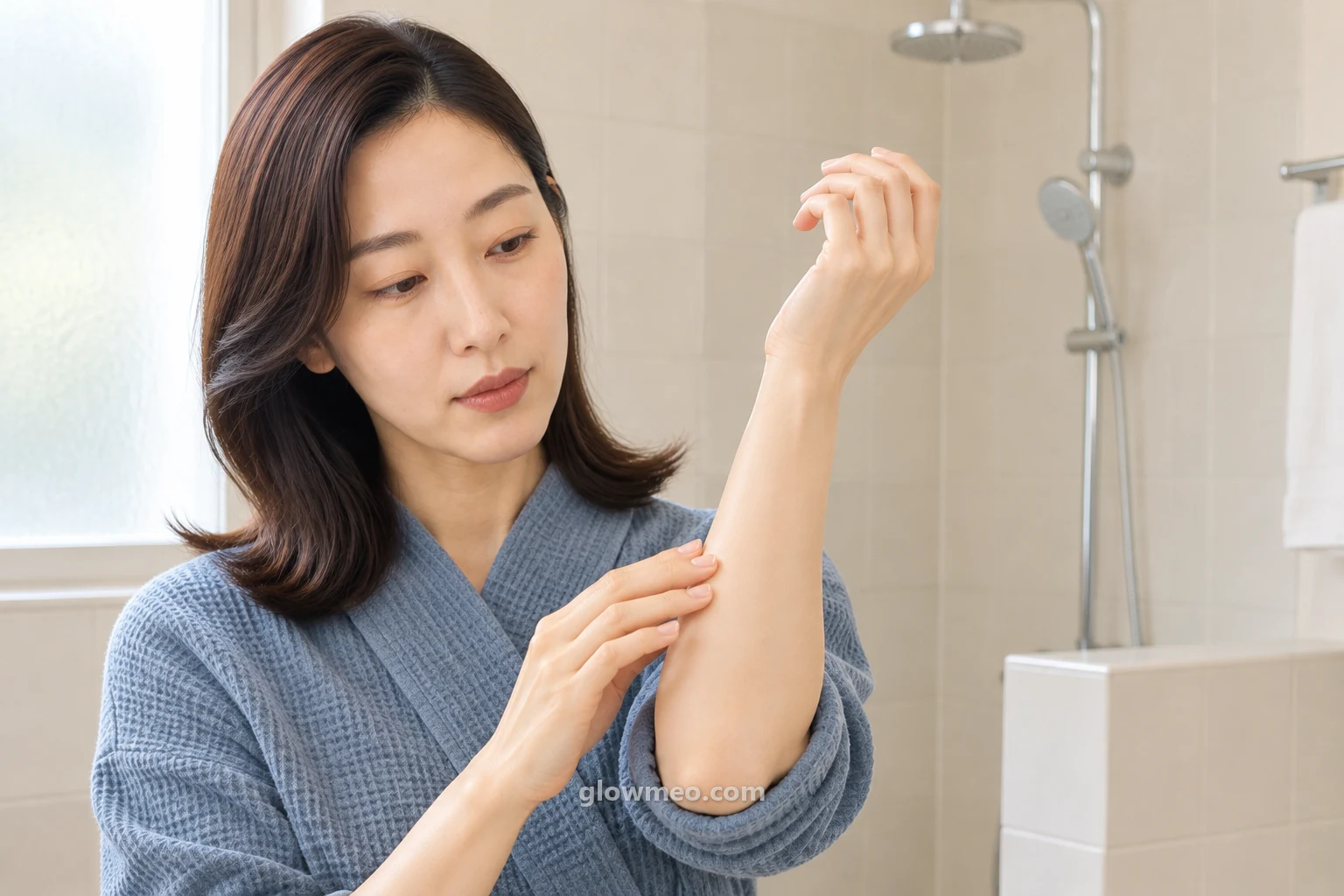
Arms, legs, and torso are places to wash. Your face, sensitive areas, and any place where the skin is broken are places to avoid.
Using a washcloth, mesh sponge, or anything other than your fingertips can irritate your skin.
If it’s your face or a sensitive area
Don’t use it. Wash your face with your fingertips. The Cleveland Clinic dermatologist said not to use it on the face or the genital area.
If you have a cut, or you just shaved your legs
Skip that spot. The same doctor said not to use it for a few days after shaving your legs, and the maker also says not to use it on broken skin (EcoTools).
If you have psoriasis or hives
The AAD says to skip loofahs, buff puffs, and washcloths for psoriasis. For hives, it says not to rub with a washcloth, loofah, or mesh sponge, and to wash gently with your hands. For skin under radiation therapy, it says to pour water over it by hand, without a washcloth, sponge, or loofah, and to ask your treatment team which products to use.
Wash your face with your fingertips
Your face is sensitive, so don’t put the mesh on it. Put cleanser on your fingertips and wash.
Instead of washing your face right away with the hand that held the mesh, rinse your hand once first.
 Face, separately
Shave last, after the shower ball
Shave at the end of your shower (AAD dry skin advice). Skin is less irritated when you shave it after water has softened it. If you wash first and shave last, the mesh doesn’t touch your freshly shaved legs that day. For a few days after shaving, keep the mesh off that spot (the same article).
On days you shave your underarms, also check the steps in the underarm hair removal guide.

On days your skin is weak, wash by hand
On days your skin is dry and tight, or red, make lather in your hands and wash with that. For hygiene too, a dermatopathologist said that well-washed hands carry less risk than sponges or loofahs (Real Simple article).
Hands may feel less refreshing than the mesh. Still, for weakened skin, the option with less friction is the right one.

Can I leave a shower ball hanging in the bathroom?
If you hang it inside the shower, it doesn’t dry well. Rinse it, squeeze out the water, and dry it outside the bathroom, where air moves.
Why is it a problem if it doesn’t dry?
The mesh is tight, so dead skin gets stuck in the gaps, and if you hang it in the shower, the inside never gets a chance to dry. The dermatologist explained that such a place becomes a good spot for germs to grow (Cleveland Clinic). E. coli, Pseudomonas, staphylococcus, streptococcus, and mold can turn up, it says.
Synthetic material is not automatically safe. A 2020 study in a Brazilian journal looked at 30 used bath sponges.
Clinically important microorganisms were found in 80% of them. That was 14 of 15 natural sponges and 10 of 15 synthetic ones. Staphylococcus aureus was found in 4 sponges and Pseudomonas in 6. Of the 15 synthetic sponges, 4 were polyethylene mesh, and after disinfection this type did better than the other synthetic sponges (original paper).
That doesn’t mean you should stop using it. The same article ends by saying you can keep using a loofah if you dry it every day, wash it once a week, and avoid sensitive areas.
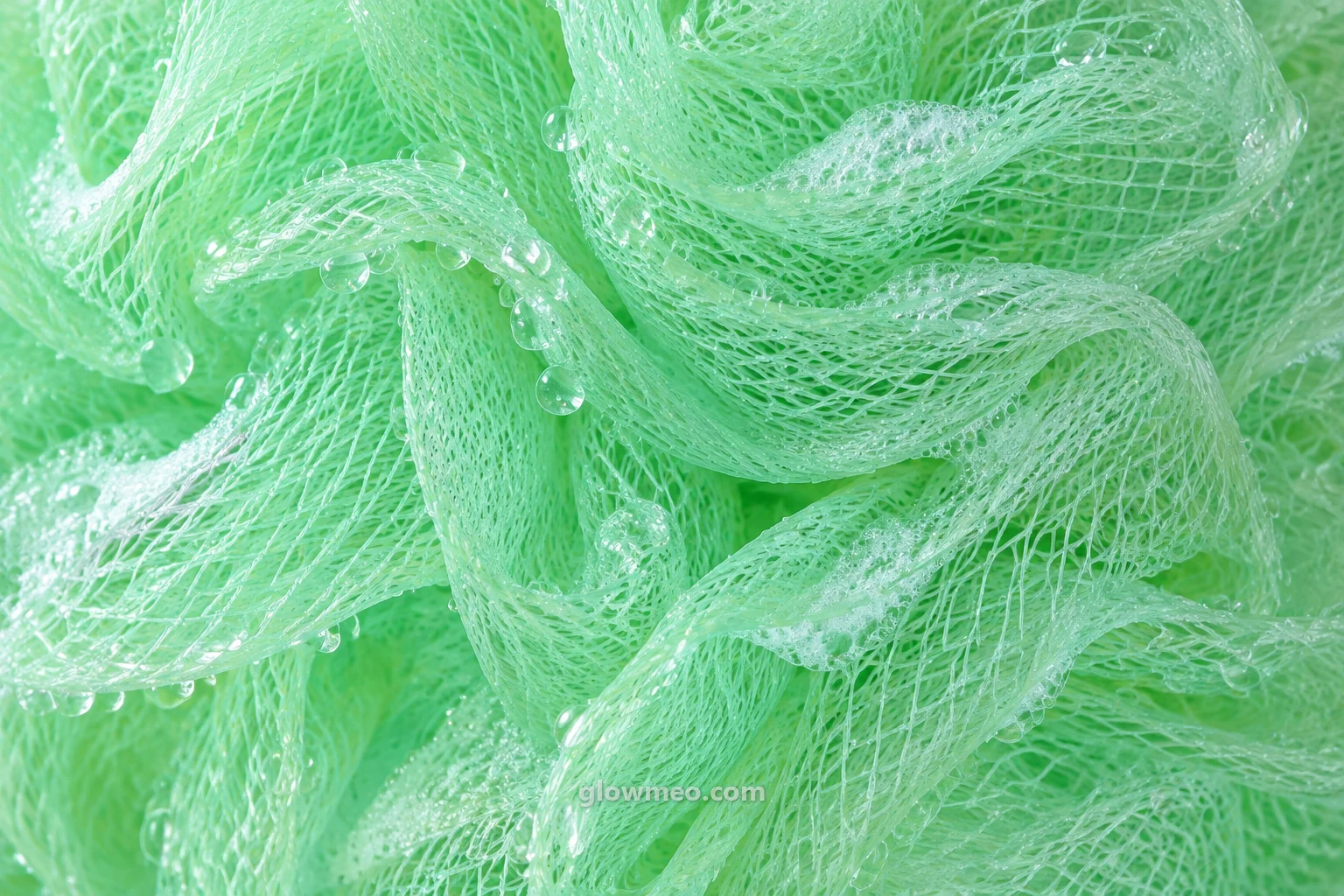
Rinse, squeeze, and dry it outside the shower
After use, rinse until no more lather comes out. Squeeze it hard with your hand or shake it out, then hang it somewhere cool where air moves, not inside the shower. A hook outside the bathroom door or by a window is a good spot.
The EcoTools product description also says to rinse and hang it to dry. Before your next shower, press it with your hand. If it feels damp, it isn’t dry yet. Next time, squeeze it harder or move it to a breezier spot.
 Squeezing hard
If you don’t have a good place to hang it outside the shower
For dry skin, there is also advice to keep the bathroom door closed during your shower (AAD). So get into the habit of carrying the mesh out with you when you finish.
Even without a hook outside the door, don’t leave it inside the shower. A report says germs multiply more in a damp bathroom, so if you can, find a cool spot outside the bathroom where air moves.
One for each person
The medical team who reported a case of infection in Canada said not to share it with family (Health Chosun report). Another report says that when several people share one, microorganisms from one person’s skin can pass to another, so it’s better for each person to have their own (Health Chosun’s English edition). Using different colors and separate hooks keeps them from getting mixed up.

How do you wash a shower ball?
Rinse and dry it after every use, and wash it separately once a week. Doctors at the same hospital said this about loofahs. Methods differ from person to person, so they are side by side in a table.
Wash it separately once a week
A dermatologist says to wash a loofah at least once a week, whether it is natural or plastic. Pick just one method from the table. Don’t stack several at once.
After washing, rinse well with clean water and let it dry all the way. If you wash it after a shower, it has time to dry before the next one.
 Weekly wash
If you use bleach, ventilate first
Follow the dilution directions and cautions on the bottle, and check whether you need protection such as gloves. Don’t mix bleach with other cleaners or disinfectants, because dangerous gas can form. Keep windows and doors open for airflow while you use it, and rinse after soaking so no smell remains (US Centers for Disease Control and Prevention).

For mold or a smell, replace it instead of washing it
If you see mold or smell a musty odor, the advice is to throw it away and use a new one, not wash it and keep using it (the same article). In that case, put it away right away so it doesn’t touch your skin.
| Method | Who said it | Good to know |
|---|---|---|
| Soak in diluted bleach water for 5 minutes, then rinse well | A Cleveland Clinic dermatologist (for loofahs) | Follow the dilution directions on the bleach bottle |
| Put it in the dishwasher | The same doctor (for loofahs) | Check the product label to see whether your mesh can take it |
| Soak in vinegar water, then rinse with clean water | A Cleveland Clinic infectious disease specialist (for loofahs · Health Chosun report) | Once a week |
How often should you replace a shower ball?
There is no single time frame. Each source says something different, so they are side by side in a table. If you see mold or smell a musty odor, replace it whatever the date.
Which row is yours?
If you have a plastic mesh shower ball, read the plastic and synthetic loofah rows together with the three rows below them. The two brands in the table also call their own mesh products loofahs on their pages. If your product’s package or description gives a replacement time, that comes first.
The numbers differ because the materials and products differ, and so do the people who said them. There is no single right answer, so look at the signs below too.
Signs to check before the date
If you see mold or smell a musty odor, replace it even if time is left. That sign comes first, whichever schedule you follow.
One report says it is better to replace it if the color has changed, even before the time is up (Health Chosun’s English edition). If it has gone flat or looks grubby, replacing it also gives you peace of mind.

Buy several so you don’t forget
One suggestion is to buy several at once and replace them often (the dermatopathologist in the Real Simple article). You don’t have to go shopping each time you replace it, so you won’t put it off.
Writing the date you replaced it on the wall next to the hook also cuts down on wondering, ‘When did I change this?’
| Who said it | Applies to | Replace |
|---|---|---|
| A Cleveland Clinic dermatologist | Natural loofah | Every 3 to 4 weeks |
| The same doctor | Plastic loofah | Can be used for about two months, it says |
| A dermatopathologist (Real Simple article) | Natural loofah / synthetic loofah | Every 2 weeks or so, at least / every 2 months or so, at least |
| EcoTools (US brand) recycled mesh bath sponge | This product | Every 30 days |
| AfterSpa (US brand) polyethylene mesh sponge | This product | Every 60 days |
| Health Chosun, 2025 report | Shower ball (no material specified) | At least once every two months |
 New and old
What should you look for on the packaging when you buy a shower ball?
Three things are enough: the replacement time, a loop to hang it, and how rough it is.
Whether a replacement time is printed
EcoTools EcoPouf lists 30 days and AfterSpa Mesh Bath Sponge lists 60 days on their product pages. It differs by product, so check the packaging yourself. If one is printed, that time is your guide.
Whether it has a loop to hang it by
Some products come with a ribbon for hanging, which makes drying easier. With a loop, finding a drying spot is much easier.
Start with the soft one
Even the same brand makes a soft product and a textured one made for exfoliating (the soft one, the exfoliating one). If your skin is delicate, start with the one labeled soft.
My skin stings after using a shower ball. What should I do?
Stop using it first and watch. If red spots or inflammation spread, see a dermatologist.
Stop using it first
The EcoTools product description warns to stop using it right away if irritation develops. One report also says to rub less hard or less often and choose a softer product (Health Chosun’s English edition).
On days your skin feels tight and stings, switch to a softer tool or your hands. Washing by hand is enough until it settles.

Moisturize right after drying off
Pat yourself dry instead of rubbing with a towel, and apply a fragrance-free moisturizer while your skin is still damp (AAD). For how to choose a moisturizer, see the body lotion guide, and for shower habits, see the autumn shower habits guide.
 Press dry
If you have red spots or a fever, see a doctor
If red spots or inflammation appear after use and get worse, you need to see a dermatologist (Health Chosun report). A Cleveland Clinic infectious disease specialist said such infections are rare (hospital newsroom), but cases exist.
A 45-year-old man in Canada developed a sore with pus on his right leg, then scrubbed that spot and his body hard with a loofah sponge, and the sores spread to his arms and the other leg. His leg turned red and swollen and he had a fever, so he went to the emergency room. The same bacteria grew from a skin sample and from the sponge he used (IDCases 2022 case report).
When you see a doctor, mention that you use a shower ball. The medical team in this case wrote that patients with skin infection symptoms and no clear cause should be asked whether they use such sponges.
Can I wash with something other than a shower ball?
Yes. You don’t need one to get clean.
Your hands are the closest tool
Hands are always with you and easy to wash. Just lather up and sweep over your arms and legs, and your body gets clean enough. Hands are also what the AAD recommends when you have psoriasis or hives.
Wash a washcloth after every use
A washcloth is named as an alternative because it is less likely to trap things in gaps and is easy to wash and dry (Cleveland Clinic). But a Real Simple article says it is only hygienic if you wash it after every use.
If your skin has become thin and dry with age, washing with a soft cloth is better (AAD).

If you also want to scrub off dead skin
Tools that scrub off dead skin are a separate topic. See the scrub towel guide for scrub towels, and the body exfoliation guide for a comparison of scrubs, peeling gels, and exfoliating body washes.
| Tool | Who said it | Good to know |
|---|---|---|
| Lather made in your hands | A dermatopathologist (Real Simple article) | Less risk than sponges if your hands are washed well |
| Washcloth | A Cleveland Clinic dermatologist | Less likely to trap things in gaps and easy to wash and dry · Hygienic only if washed after every use (Real Simple) · With psoriasis or hives, use your hands instead of a washcloth (AAD) |
| Silicone scrubber | A Cleveland Clinic infectious disease specialist | Named as an alternative that is easy to care for, along with a washcloth |
| Soft cloth | AAD (skin advice for people in their 60s and 70s) | Buff puffs and body brushes can irritate |
Questions that come up as you use a shower ball
It depends on who you ask. A Cleveland Clinic dermatologist said there is no reason to use a loofah more than twice a week, while EcoTools presents its soft mesh product for daily washing. Read the directions for your product first, and stop right away if your skin turns red or stings.
Hard rubbing, or using enough body wash to make thick lather, can dry your skin. For dry skin, the AAD advises using only enough body wash to wash off dirt and oil, and applying a fragrance-free moisturizer while your skin is still damp after washing. If the tightness continues, rest the mesh and wash by hand.
Pick just one of the methods in the table. A Cleveland Clinic dermatologist mentioned diluted bleach water, and an infectious disease specialist at the same hospital mentioned vinegar water. Don’t use both together or one after the other. Mixing bleach with other cleaners can release dangerous gas (US Centers for Disease Control and Prevention). After washing, rinse well with clean water and dry it all the way.
It’s better not to share. The medical team who reported the Canadian case said not to share it with family (Health Chosun report), and another report says microorganisms from one person’s skin can pass to another when several people share one (Health Chosun’s English edition). Use one each, with separate hooks.
Three things to remember when you hang it up after a shower
Rub lightly, rinse and squeeze out the water, and dry it outside the shower. These three things are all you need to remember before you hang it up. If you see mold or smell a musty odor, replace it with a new one and don’t hold back because it feels wasteful.
Read next
- How to Choose Hand Wash: Regular Soap for 30+ Seconds Over “Antibacterial” Wording
- When Your Skin Barrier Is Weakened: Habits to Cut Back and What to Add to Damp Skin
- How to Choose a Low-pH Foam Cleanser: Reading the “Low pH” Label and Cleansing Ingredients
- Unscented vs. Fragrance-Free: Korea’s Labeling Rules Don’t Tell Them Apart, So the Ingredient List Decides
- Browse Glowmeo’s beauty supplies guides


