
Back and Chest Acne and Body Wash: Sweat, Friction and the Back Label
Sweat left on after a workout and the rub of backpack straps can make back and chest acne flare. How to wash without scrubbing, how to read the “functional cosmetic” wording and rinse-off directions on a Korean body wash, and when to see a dermatologist.


When you drop your backpack after a workout, the sweaty T-shirt is often still stuck to your back right where the straps ran. With breakouts on the back and chest, I’d suggest starting with how you handle sweat and friction, not what you wash with. The sweat from exercise and the oil, dirt and bacteria that build up on your skin can all lead to acne, and anything rubbing against your back, like a backpack, can make back acne flare (American Academy of Dermatology, AAD).
It covers the order in which to fix everyday habits for back and chest acne, and how to read the “functional cosmetic” wording — a Korean regulatory label — on the back of a body wash. Cases where a doctor comes before any body wash, such as deep, painful lumps, are gathered in the last section. Exfoliating products such as scrubs and peeling gels have their own guide on body exfoliation.


Merphil
AC+ Magic Cleanser Body Wash
500 g
Read the functional-cosmetic label and rinse-off directions before choosing a body wash. Don’t carry a waiting time from US guidance over to a different product.
View on NaverHow do sweat and friction linger on your back?
Sweat, friction and greasy products that coat the skin. Dermatology associations name these again and again as the everyday causes that make body acne flare.
Sweat left on after a workout
Working out can make you sweat heavily and lets oil, dirt and bacteria build up on your skin, and all of these can lead to acne (AAD). That doesn’t mean you need to stop exercising — the key is good hygiene before, during and after a workout (same guidance).
Shower and change clothes as soon as you can after exercising or sweating (AAD back acne guidance). Start by cutting down the time you spend resting on the sofa in a wet T-shirt.
 Backpack straps
Where straps and gear rub
Acne that forms when sports gear or clothing traps heat and sweat against the skin and rubs the heated skin has its own name, “acne mechanica” (AAD). For people who carry backpacks, the backpack, and especially its shoulder straps, is the example given (same guidance).
It starts as small, rough bumps you feel with your fingertips before you can see them, and if you keep using the gear without any precautions, they can turn into pimples or deep acne (AAD). Avoid anything that rubs against your back, such as a backpack (AAD back acne guidance).
Greasy products that coat the skin
Greasy skincare products, greasy moisturizers, hair products and greasy substances you contact at work can cause or worsen acne (British Association of Dermatologists, BAD).
Ointments and moisturizers containing paraffin, as well as adhesive plasters, can bring on sterile folliculitis, and if you need a moisturizer, choose an oil-free one that coats the skin less (DermNet, a New Zealand skin information site). It’s worth checking the body lotion you put on your back and chest after a shower by the same standard.
Which habits start with your workout clothes and towels?

A loose cotton T-shirt
When you work out, wear loose-fitting clothes made of cotton or sweat-wicking fabric (AAD). Swapping tight workout clothes for loose ones helps keep heat and sweat from being trapped against your skin (same guidance).
For clothing that sits right against the skin, fabric that wicks sweat away from the body reduces friction and irritation (same guidance). If gear touches your skin directly, the AAD suggests placing a clean, soft pad in between.
 Wash after one wear
Wash workout clothes after one wear
Wash workout clothes after each use (AAD). The reason: dead skin cells, bacteria and oil left in unwashed clothes can clog pores and lead to acne.
So when you head out to exercise, wear clothes that have been washed since you last wore them. The same guidance says not to share helmets or shoulder pads that several people use, and to wipe down shared equipment before you use it.
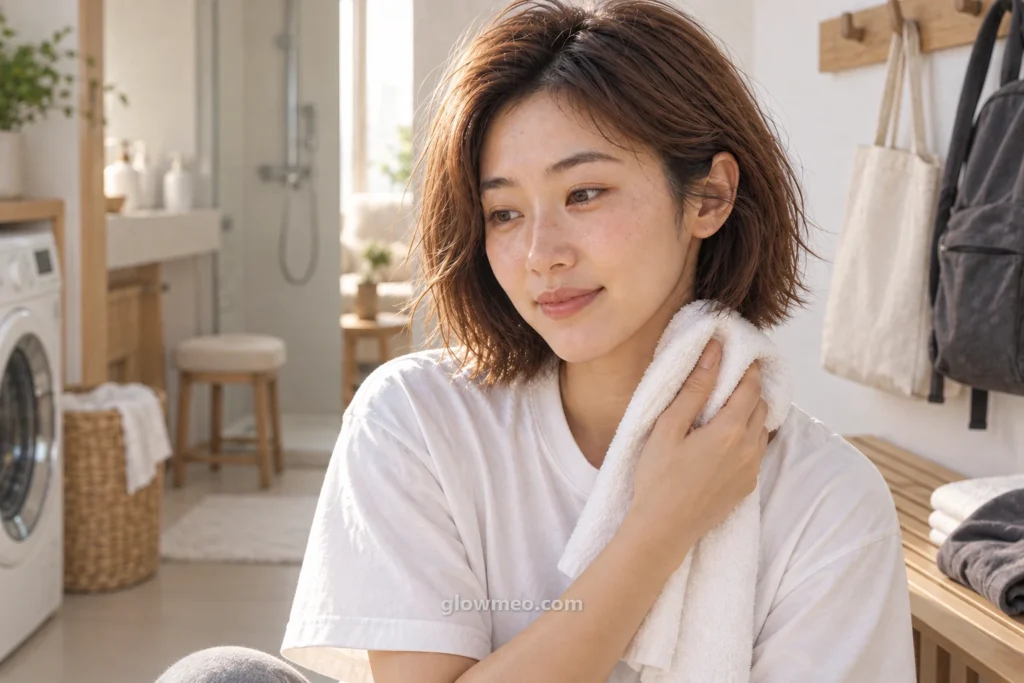
Pat the sweat away
While you exercise, gently pat sweat off your skin with a clean towel (AAD). Rubbing at the skin can make acne flare up, and roughly wiping sweat away with a towel is a habit that can irritate the skin and bring on breakouts on its own (same guidance).
A clean towel here means one that was washed after anyone, whether you or someone else, last used it. When you dry off your back and chest after a shower, treat them the same way: press a clean towel against your skin to soak up the water.
How can you tell apart things that look like acne?
Not everything on your back and chest is the same kind of acne. The BAD also notes that not every spot is acne and says to talk to a healthcare professional if a rash looks different from usual. Here, what the organizations describe sits side by side with what to do about it.
If the bumps are itchy and uniform
Malassezia (Pityrosporum) folliculitis shows up as small, uniform, itchy papules and pustules, mainly on the upper back and chest (DermNet). What usually sets it apart from ordinary acne is the absence of comedones such as blackheads and whiteheads (DermNet).
Hot, humid weather, heavy sweating and skin covered by moisturizer or sunscreen are risk factors, and because it resembles acne, diagnosis is easily delayed (DermNet). When a doctor suspects it, they test a sample such as skin scrapings to confirm the yeast (DermNet).
So if you see small, uniform, itchy papules and pustules on your upper back and chest, get them checked by a dermatologist first rather than switching body washes and waiting.
| What it looks like | What the guidance says | What to do next |
|---|---|---|
| A mix of blackheads, whiteheads, and pimples, nothing painful or deep | The AAD counts this kind of back acne as something you can try treating at home | Change your washing habits, clothes, and bags alongside acne treatment; if nothing changes after 6–8 weeks of treatment, see a dermatologist |
| Small, rough bumps where bag straps or gear touch | The AAD describes this as the first sign of acne mechanica | Change what touches the skin or add a pad, and wear loose clothes |
| Itchy, uniform bumps spread across the upper back and chest, with no comedones | DermNet describes this as how Malassezia folliculitis presents | Get it checked by a dermatologist |
| Deep lumps that hurt to the touch | The AAD says this needs a dermatologist’s care | See a dermatologist |
 Around the shoulder blades
Why does scrubbing harder make acne worse?
The feeling that you have to scrub hard to get clean is where the guidance from dermatology associations pushes back hardest.
Blackheads aren’t caused by not washing enough
Blackheads aren’t caused by poor washing, and scrubbing too hard can irritate the skin and make acne worse (BAD). Scrubbing acne-prone skin may seem best but actually worsens acne (AAD).
Antibacterial soaps, astringents and abrasive scrubs can worsen acne, and so can loofahs, back brushes and buff puffs (AAD back acne guidance).
Your back is hard to reach, so it’s tempting to grab a tool, but by the AAD’s back acne guidance the back brush stays on its hook.
| The easy habit | What actually happens | Instead |
|---|---|---|
| Scrubbing hard with a back brush or loofah | The AAD says loofahs and back brushes can worsen acne | Lather with your fingertips and wash gently |
| Rubbing sweat off with a towel | Guidance says rubbing can make acne flare | Pat it dry with a clean towel |
| Squeezing the pimples you can reach | Both the AAD and the BAD say not to squeeze — the BAD cites scarring and infection | Leave them alone |
| Trying an acne treatment for a week or two, then switching | The AAD says it takes 6–8 weeks of use to see improvement | Give an acne treatment 6–8 weeks before deciding if it works |
| Believing the sun dries out acne | The AAD says sun tends to darken acne and make it last longer | Apply non-comedogenic sunscreen to skin your clothes don’t cover |

Why look for “functional cosmetic” first on the back of the body wash?
In Korea, the only cosmetics that may claim easing acne-prone skin as an effect are rinse-off body cleansers. Body wash falls right into that slot.
0.5%
Salicylic acid levels in acne-prone-skin functional cosmetics exempt from data submission
2%
Salicylic acid limit for body cleansers, allowed only as a functional cosmetic active
 Reading the back
Easing acne-prone skin: rinse-off products only
In a December 2024 legal interpretation, the MFDS stated that Article 2 of the Enforcement Rule of the Cosmetics Act, in naming cosmetics that help ease acne-prone skin as functional cosmetics, limits them to body cleansers. In other words, only body-cleansing cosmetics can be reviewed or reported for this function under Korean rules.
So if you’re searching for a product labeled for acne-prone skin, you’ll find it among rinse-off cleansers, not leave-on lotions or mists. The first check is whether the back of the bottle shows both the words “functional cosmetic” and the efficacy wording.
The efficacy wording and the rinse-off directions
Annex 4 of the MFDS notice “Regulation on the Review of Functional Cosmetics” defines the acne-prone-skin products exempt from submitting supporting data as soap-based body cleansers in liquid, lotion or cream form, excluding forms soaked into nonwoven pads and the like.
Annex 4 restricts the efficacy claim to “Helps ease acne-prone skin” and the directions to “Take an appropriate amount, use on the skin, then rinse off right away with water.”
The same table sets the ingredient and strength: salicylic acid at 0.5%. If the directions on the back carry this sentence, apply as written and rinse right away. That’s a different method from the US benzoyl peroxide washes covered below, which you leave on for a few minutes.
Salicylic acid: up to 2% in cleansers
Annex 2 of Korea’s “Regulations on Safety Standards, etc. of Cosmetics” lists salicylic acid as an ingredient that needs usage restrictions, allowing up to 2% in body cleansers but only when it’s used as the active ingredient of a functional cosmetic. Rinse-off hair products have a separate limit of 3%, and as a preservative it’s capped at 0.5%.
The same table bars salicylic acid from products for infants and from products labeled specifically for use by children aged 13 and under (shampoos excepted). That also means you won’t find this ingredient in a body wash labeled for kids.
The AAD explains that salicylic acid helps unclog pores.
What do you read on a bottle that doesn’t say “acne”?
“Acne” on ordinary cosmetics, and the exceptions allowed
The MFDS’s “Guidelines for Cosmetic Labeling and Advertising” list “acne” as a prohibited expression. The exceptions are efficacy wording reviewed or reported for a functional cosmetic, and the substantiated phrase “suitable for use on acne-prone skin.” The MFDS explains that even when the same meaning is written in a foreign language such as English, it can be judged a prohibited expression from the overall impression of the ad.
So if a body lotion or body mist that isn’t a functional cosmetic says it gets rid of acne, that wording is out of line with the labeling rules. Article 13 of Korea’s Cosmetics Act also bans labeling and advertising that could lead people to mistake a product for a drug.

Non-comedogenic, oil-free, fragrance-free
Use oil-free products on acne-prone skin; the packaging may carry words such as “non-comedogenic,” “non-acnegenic,” “won’t clog pores” or “oil-free” (AAD). The BAD also suggests starting with products labeled “non-comedogenic” or “oil-free” that suit spot-prone skin.
Leave out the fragrance. Use gentle, fragrance-free skincare products (AAD back acne guidance); antibacterial soaps and astringents are among the products that can worsen acne (same guidance).
Why does US guidance say to leave a benzoyl peroxide wash on for 2–5 minutes?
Leave it on your back for 2–5 minutes, then rinse. That’s how the AAD says to use the benzoyl peroxide foaming wash it suggests for back acne — a product sold without a prescription in the US.
Why it stays on your back for a few minutes
The AAD explains that benzoyl peroxide helps kill the bacteria that cause acne, and that used daily, it can help control back acne and reduce new breakouts. Studies show it works best when left on the back for 2–5 minutes, it notes.
There are two reasons. The skin on your back is thicker than on your face, so the medicine needs time to sink in, and rinsing it off afterward keeps your clothes, sheets and towels from bleaching.
Towels and sheets can lose their color
The AAD notes that benzoyl peroxide is known to bleach fabrics. If you use this wash, rinsing it off thoroughly after a few minutes is just part of the routine.

5.3% and 10%: US strengths
Benzoyl peroxide foaming washes sold without a prescription in the US come in several strengths. The AAD says a 5.3% product is less likely to cause irritation, dryness or peeling, and that if you feel you need something stronger, you can start with a 10% wash — the strongest concentration you can buy without a prescription.
These numbers refer to over-the-counter options in the US. In Korea, the ingredient that Annex 4 of the MFDS notice sets for data-exempt acne-prone skin products is salicylic acid at 0.5%, so that is not the name you will find on the back of a Korean body wash.

For the back you can’t reach
The medicine needs to go on your back, but your back is hard to reach. The AAD suggests that keeping a lotion applicator with a handle for your back can help you apply the medicine where you want it.
The BAD says to apply topical treatments to the whole area affected by acne rather than to individual spots, and the AAD likewise says to spread a thin, even layer over the whole area that tends to break out. Dabbing only the spots you can see won’t stop new ones from coming up, they explain.
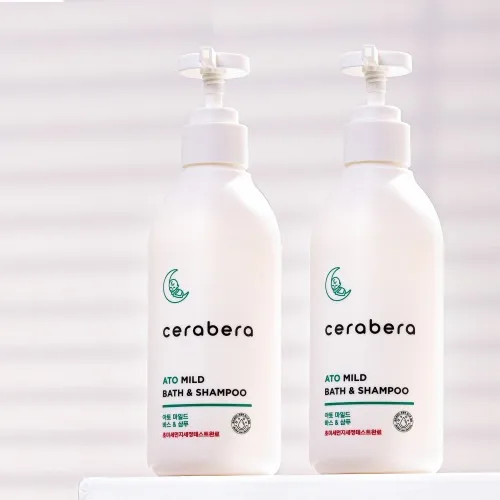
Cerabera
Ato Mild Bath & Shampoo, Unscented
300 ml × 2
A bath and shampoo wash to compare when reading fragrance labels. Check the unscented label and ingredient list, and wash gently with your fingertips.
View on NaverHow do you lather with your fingertips and rinse with water that isn’t hot?
 Fingertips only
Small circles, fingertips only
When washing acne-prone skin, on the face or elsewhere, apply a gentle, non-comedogenic cleanser lightly with your fingertips in a circular motion (AAD). To rinse, use lukewarm water and just your fingers too, and pat the skin dry with a clean towel (same guidance).
Anything that irritates the skin, such as scrubbing or hot water, can make breakouts flare up (AAD). Instead of working up a heavy lather and rubbing for a long time, just smooth the foam on with your fingertips and rinse.
If it stings, use it less often
Some topical treatments can dry or irritate the skin when you first use them (BAD). If your skin turns red and irritated, the BAD suggests stopping for a few days, then using the product less often and building up gradually. If the irritation continues even after you cut back, talk to a healthcare professional (same guidance).
Don’t use astringents or acne products until your skin dries out (AAD acne habits guidance); dry skin is irritated skin (same guidance). If your skin feels tight, the AAD suggests a moisturizer made for acne-prone skin.
How do you get through a workout-and-backpack day, from morning to night?
Before you head out
On workout days, grab clean workout clothes first. If you’ll be exercising outdoors in the daytime, put on an oil-free sunscreen before you go (AAD). When the sun dries out your skin, it can produce more oil and clog pores (same guidance).
On days you wear something that shows your back, apply sunscreen to all the skin your clothes don’t cover. Choose a sunscreen that’s non-comedogenic, SPF 30, broad-spectrum (blocking both UVA and UVB) and water resistant (AAD). For when to reapply, see reapplying sunscreen.

After your workout
Shower and change as soon as you can after your workout. If you can’t wash right away, gently wipe sweaty skin with an oil-free cleansing wipe and change out of your sweat-soaked clothes first (AAD).
The AAD’s workout guide also suggests, when a shower is not possible, changing out of your gym clothes and wiping breakout-prone spots with pads containing salicylic acid. That helps keep pores from clogging, they explain.

Bag in hand, laundry right away
Use a handheld bag instead of a backpack, and, if you carry a shoulder bag, hook the strap over your arm (AAD back acne guidance). The reason: anything that rubs against your back can irritate the skin and make back acne flare.
When you get home, put the workout clothes you wore and the towel you used for sweat in the laundry basket. Start your next workout again with washed clothes and a clean towel.
Why wait 6–8 weeks, and then 12 weeks?
The timelines differ by organization. Here are the AAD’s and the BAD’s numbers side by side.
6–8 weeks
When improvement starts if a treatment is working
3–4 months
How long complete clearing can take
12 weeks
Minimum time to keep treating before visible improvement
Switching every week wears out your skin first
The AAD notes that if back acne treatment works, you may start seeing results in 6–8 weeks, and clearing completely can take 3–4 months.
The AAD’s guidance on acne habits cautions that trying a new treatment every week or so can actually irritate skin and trigger breakouts, so it recommends giving a single treatment 6–8 weeks.
The BAD says most treatments take 2–4 months to reach their full effect and advises using them for at least 12 weeks before expecting a noticeable improvement. The numbers differ, but both organizations come down on the side of not judging within a few weeks.
Acne mechanica clears a little faster
The AAD says acne mechanica tends to clear faster than ordinary acne, but if it’s still there after 6–8 weeks of treatment, a dermatologist can help. Prescription medication may be needed, it notes.
Mark on a calendar the day you start treatment and the day you change your straps and gear, and you’ll have a baseline to compare against 6–8 weeks later.
When do you see a dermatologist before trying another body wash?
When it’s deep and painful, or nothing changes in 6–8 weeks
The AAD says anyone with deep, painful acne, on the back or anywhere else, will need a dermatologist’s help. It also says that if you don’t see any difference after 6–8 weeks of treatment, you may need a dermatologist’s help.
The BAD likewise says to see a healthcare professional if over-the-counter products haven’t worked, and stresses that treating acne as soon as it appears matters, so it doesn’t leave scars.

When itchy, uniform bumps spread
If itchy bumps of the same size are spread over your upper back and chest and there are no blackheads, that resembles the Malassezia folliculitis DermNet describes. Before trying one body wash after another, get examined by a dermatologist and, if needed, have a sample tested to confirm the yeast.
At the clinic, tell them when it started, whether it itches, whether you’ve been sweating a lot lately, and whether you’ve started a new moisturizer or sunscreen. These are the risk factors DermNet lists.
When your mood sinks too
The BAD says acne can have a big effect on self-esteem and mood, and that if you feel low or anxious, you should tell a healthcare professional about that too. It also encourages reaching out to friends, family or support groups.

CottonCloud
Air Cotton Hotel Towels
40-count combed cotton · 200 g · 10 towels
Pat sweat and shower water off with a clean towel. Wash the towel you used for exercise and use a clean one for your next workout.
View on NaverWhy leave the back brush on the hook?
Let’s go back to the opening scene. On the evening you drop your backpack after a workout, you now pull off the wet T-shirt first, toss it in the laundry basket and head straight to the shower. With the back brush left on its hook, you place the lather on with your fingertips, wash gently and rinse with lukewarm water.
With body wash, read the back first. If it shows both “functional cosmetic” and “Helps ease acne-prone skin,” follow the directions and rinse right away; if those words aren’t there, check for non-comedogenic and fragrance-free labels. Pat yourself dry with a clean towel, and send that towel to the laundry basket too.
If the bumps are itchy and uniform, get them checked by a dermatologist first. And if nothing has changed after 6–8 weeks of acne treatment, see a dermatologist then as well.

Back and chest acne: what questions come up in the shower?
The AAD says back acne needs treatment along with acne-friendly skincare, and also lists showering and changing quickly after sweating, loose cotton workout clothes, and avoiding anything that rubs your back like a backpack (US guidance). Rather than changing only the cleanser, change your sweat and friction habits along with it.
The AAD says loofahs, back brushes and buff puffs can worsen acne, just like abrasive scrubs (US). The BAD also says scrubbing too hard can make acne worse. Place the lather on with your fingertips and wash gently.
In Korea, functional cosmetics that help ease acne-prone skin are limited to body cleansers (MFDS legal interpretation, Dec. 12, 2024). Annex 4 of the “Regulation on the Review of Functional Cosmetics” sets the directions for these data-exempt products as “Use on the skin, then rinse off right away with water.” Check for both the “functional cosmetic” label and the efficacy wording on the back.
The AAD says to leave a benzoyl peroxide foaming wash, sold without a prescription in the US, on your back for 2–5 minutes and then rinse. The skin on the back is thick, so it needs time to sink in, and because it bleaches fabric, rinsing it off keeps clothes, sheets and towels from fading. The 5.3% and 10% strengths are US figures.
The AAD says that if a treatment works, improvement may start in 6–8 weeks and complete clearing can take 3–4 months. The BAD says to use it for at least 12 weeks before expecting a noticeable improvement. If nothing changes in 6–8 weeks, or if it’s deep and painful, see a dermatologist.
What are the three lines to tape to the shower door?
For back and chest acne, start with washing off sweat quickly and cutting down friction. For body wash, read the “functional cosmetic” label and the rinse-off directions on the back, then wash gently with your fingertips. If nothing changes after 6–8 weeks of acne treatment, or if it’s deep and painful, or itchy and uniform, see a dermatologist.
Read next
- Body exfoliation, picking a scrub, peeling gel or exfoliating body wash
- Reapplying sunscreen, when to reapply outdoors, in water and after sweating
- Cooling body wash: where to use it and how it feels before the chill
- Choosing a body lotion, texture, where to apply and how skin responds
- All Glowmeo skincare guides


