
Can You Leave Cosmetics in a Hot Car? Summer Storage for Sunscreen, Cushions and Sprays
If you have left cosmetics in a hot car, start with each product’s storage guidance. Changes in the container, colour, smell and texture, and the cautions for sunscreen and sprays.

Summer beauty guide
If you have found cosmetics left in a hot car, look at the container and the contents for changes. Here are the situations where you should stop using a product and check, and what to take with you next time you go out.

If you take a pouch out of a parked car and the sunscreen and cushion feel hot, you may well wonder whether you can keep using them. The number of hours in the car is not enough to settle the answer on its own. Beyond the product’s texture, container and stated storage conditions, you also need to look at where it was sitting and how it was exposed.
That said, it is also hard to brush it off with “the outside looks fine, so it must be all right”. Cosmetics commonly carry advice to avoid heat and direct sunlight, and sunscreens and aerosol products in particular need more care over the container and the storage environment. The FDA’s guidance on storing cosmetics also recommends not keeping cosmetics where they are exposed to high temperatures and direct sunlight.
Do not apply the product you have found as a trial; I suggest first looking for anything that has changed in the container or the contents. If it has been outside the storage guidance, or you are unsure whether it can be used, give the manufacturer the product name and the exposure situation and ask.

Yuna’s summer storage note
With cosmetics left in a car, look first at “what product, and in what state” rather than “how many hours”. Not leaving the day pouch in the car, and taking it with you when you get out, is the simplest prevention.

Avène
Sun Mineral Cream
50 ml · SPF50+ PA++++
Avoid leaving products in a car, and check the storage directions for each texture and container on the product label.
View on NaverHow do you take your cosmetics with you when you leave the car?
Even if it feels fine with the air conditioning on, the environment inside the car changes once it is parked. Putting things in a storage compartment does not keep the storage conditions either. If leaving things for a moment keeps happening, I suggest building the habit of putting them in your day bag and taking them out with you.
Avoid direct sunlight and excessive heat and follow the storage guidance printed on the product. Not every cosmetic needs to go in the fridge. Whether to refrigerate is also best checked against each product’s labelling.
Day pouch
Choosing a pouch that is easy to carry
Keeping what you need while out in one place makes it easier to gather up when you leave the car. Before buying a new pouch, look first at whether you can carry things in the bag you already use.
If you need a pouch, check the size and washing method against what you will actually put in it. Do not assume that lots of compartments or a thick body will prevent high-temperature storage.
- When you want to carry just sunscreen, a lip product, and a cushion separately
- When you want to keep a damp puff away from other products
- When you want to build the habit of taking your pouch with you whenever you leave the car
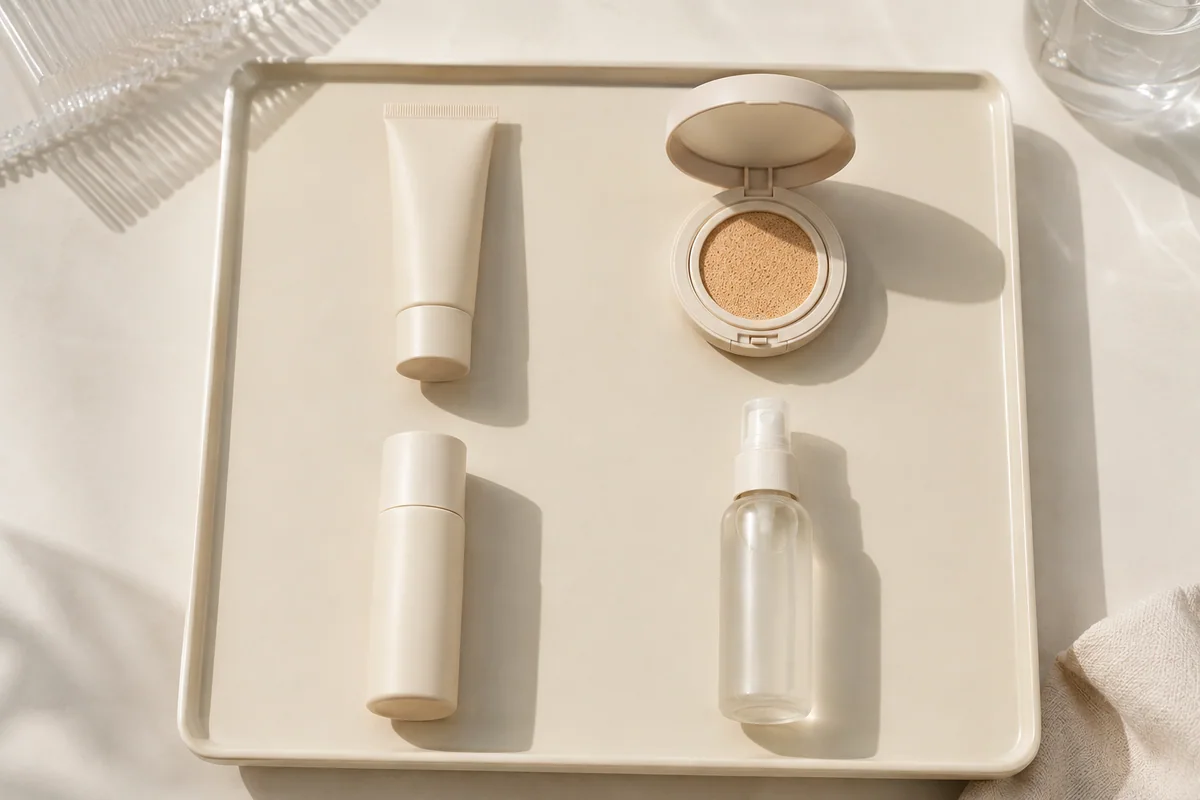
For sunscreen, look at the storage guidance; for a cushion, the contents and the puff; for lotions and creams, any change in texture from how it was. For aerosol products, check the container’s cautions about high temperatures first.
After it has been in the car, why is judging by the hours alone something to avoid?

The fact that something was in the car cannot, by itself, settle the performance or safety of a particular product. After heat exposure, though, there is good reason to check whether it has changed from how it was.
Even if it looks normal on the outside, that alone cannot confirm whether it can be used. Instead, treat any change from the original in smell, colour, texture or container as a signal to stop using it and check.
Once you have taken the product out, put it somewhere cool indoors first, and do not squeeze it out in a hurry or apply it several times to check while it is still hot enough to feel hot in your hand.
Even inside the same car, temperatures vary from spot to spot
Make a note of where it was, so that you can explain it to the manufacturer too. It helps to say whether it was in direct sunlight and roughly how it was exposed. Do not decide it was safe simply because it was in a shaded spot.
In its 25 July 2025 announcement, the Korea Transportation Safety Authority reported that with a sunshade in use the dashboard was 20 ℃ cooler and the cabin 2 ℃ cooler. That is the result of that particular test, not data measuring the temperature or safety of cosmetics themselves. Korea Transportation Safety Authority — original source
Even inside the same car, exposure conditions can differ with direct sunlight, which way the windows face and where the measurement was taken. Do not apply the peak temperature you saw in an article to every spot in your own car or to a particular cosmetic; put the product’s storage labelling and the manufacturer’s guidance first.
| Spot | How the heat arrives | Take particular care with |
|---|---|---|
| Dashboard · below the windscreen | A spot that can be in direct sunlight. In the test above, the dashboard temperature was 20 ℃ lower with a sunshade in use. | Stick and balm formulas, cushions, and lip products |
| Door pockets | Conditions can differ depending on which way the window faces and whether the sun comes in. | Spray and aerosol containers |
| Centre console · glove box | Being closed does not mean the cosmetics’ storage conditions are being kept. | Changes in the formula of squeeze tubes and pump bottles |
| Footwell · under the rear seats | Shaded, with little direct exposure of the surface | Still not a place for permanent storage |
| Boot | Out of sight, so it is easy to leave a product there and forget it. | A spot where things get forgotten for a long time |
The table is a prompt for thinking back over where things were in the car. The temperature differences above come from one particular test, so they don’t mean the same effect will happen in your car or with your cosmetics.
We do not judge safety from appearance alone after heat exposure
Shifts in temperature, along with exposure to sunlight and air, can alter a cosmetic’s colour, texture, and smell, and emulsions can separate (FDA). A change you can see, though, cannot diagnose which ingredient or internal structure has been damaged.
When the container looks wrong
If you spot a lifted cap, a leak, or a swollen or cracked container, don’t open or spray it to check on your own. In particular, don’t try to handle or move a very hot or damaged aerosol with bare hands. With aerosols, follow the high-temperature and fire cautions on the container, and if you aren’t sure whether it is damaged, ask the manufacturer.
Appearance alone cannot tell you whether it can be used
Even if the colour and texture look normal, you cannot confirm by eye that it is in the same state as before the heat exposure. On the other hand, if a clear change is visible, you should stop using it and check.
It is hard to set an arbitrary point where every product should be thrown away. Check the use-by date and the storage labelling, and if it has sat outside those storage conditions or feels hard to judge, ask the manufacturer.
Even if it has cooled and returned to shape, it still needs checking
A softened stick or balm can set again. But don’t decide it can be used simply because the shape has come back. Note the exposure situation and what has changed, and check that product’s guidance.
Telling it apart from a product that is meant to be shaken
Depending on the product, separation may just be how it was designed, meant to be shaken before use. If separation persists even after following the normal directions, or there is a change in colour, smell, or texture, or something wrong with the container, stop using it and check with the manufacturer. We do not judge from appearance whether the structure has recovered.

Next, read the storage wording on the product label or outer packaging. The guidance put first can differ from product to product, such as “avoid high temperatures”, “avoid direct sunlight”, or “do not use if the container is damaged”. For the exact storage temperature or whether it can be used, the manufacturer’s guidance takes priority over the general criteria in this article.
In what order do you check the container, smell, texture and leaks?

Before using a product again, look at the container and the contents separately instead of starting with a test on the back of your hand. The reason for checking container changes first, whether the cap has lifted or a gap has opened, whether the tube has swollen too much, or whether the pump is abnormally loose, is simple. It isn’t just the contents that need looking at, but the storage environment and the state of the container as well.
Even if the texture looks as though it has recovered after cooling, that doesn’t prove it is safe. Note down any container damage, changes in smell, colour, or texture, and the exposure situation, and check with the manufacturer whether it can be used.
- Whether there is a strong smell that was not there before
- Whether the colour has changed unevenly or looks blotchy
- Whether it has split into distinct layers, like water and oil, or become far too thin
- Whether there is a leak, deformation or crack at the cap, pump or spray opening
- Whether the current situation clearly contradicts the storage conditions on the label
This list cannot judge safety. If there is a change that was not there before, or clear container damage, don’t test it on your skin; stop using it and check with the manufacturer.

Because the normal texture and directions differ from product to product, don’t conclude that something has spoiled from one phenomenon that looks like separation. Look at whether it comes with a clear change in colour, smell, or texture that you can compare against the original, and if the change is marked or hard to judge, stop using it and ask the manufacturer.
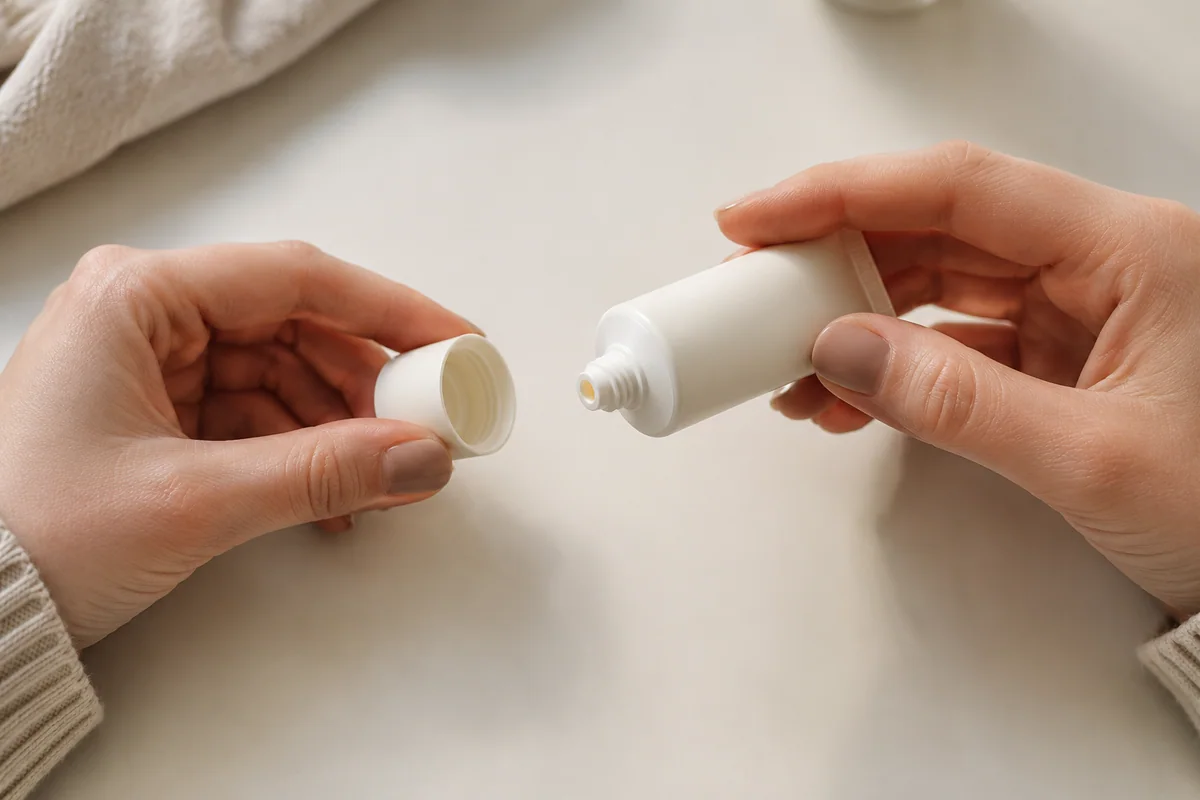
In particular, if there are traces of a leak, look at the other products in the pouch as well. A closed lid doesn’t always mean the seal has held, and contents around the cap after heat exposure are a signal to recheck the container and the product guidance.
If there is a stain soaked into the pouch’s inner fabric, it is worth washing or replacing that pouch too.
With sunscreen, why does the habit of not leaving it in the car matter most?

Sunscreen is the product you take out most often on summer outings, and for that very reason the one most easily left behind in the car. Sunscreen containers should be protected from excessive heat and direct sunlight (the FDA’s sunscreen guidance). Keeping it in the car is convenient, but it sits a long way from that principle.
Sunscreen routine for going out
- Instead of leaving it in the car, carry it inside your bag or among shaded belongings and move it with you
- Check a product taken out of the car — cap, leaks and texture first
- Check how you reapply and the storage condition separately

If you’re wondering when and how to reapply your sunscreen, see our sunscreen reapplication guide. And if you’re trying to choose a format to carry around, the differences between lotions, sticks, and sprays are worth looking at too. Even once you have chosen a format, check the storage guidance for your current product separately.
Insulated pouch
If you are considering an insulated pouch
Even with an insulated pouch, do not leave cosmetics in a parked car. Whether the storage conditions stated on the product can be kept has to be checked separately.
Check that the size takes the products you need and how the pouch is actually used. The word insulated alone cannot tell you the temperature or the time it holds.
- When you want to set aside a minimum set of products for going out
- When you want to keep sunscreen apart from the rest of your belongings inside your bag
- When you want one fixed pouch to grab when you leave the car
Why does a cushion need the contents and the puff looked after separately?

A cushion is easy to leave in the car, and because the contents and the puff are used together repeatedly, there are two things to check. First, look at whether the case has warped or the closure has loosened, and whether the smell, colour or texture of the contents differs from before. Then check separately whether the puff has stayed damp for a long time or become soiled.

Keeping the puff clean does not resolve the problem of a cushion having been exposed to high temperatures. Check the contents and the state of the case separately, and wash the puff as the product guidance says and dry it thoroughly. If you are wondering about the colour darkening after application, how to look at summer cushion darkening is worth a read.
Puff storage
If you want to store the puff separately
Look at whether a clean, dried puff can be stored without touching other items. A ventilated case does not mean you can leave a damp puff inside it.
If you already have a case, check first whether it is easy to keep clean. When choosing a new case, it helps to look at the puff size along with the washing and drying method.
- When you want to keep a spare puff apart from makeup products
- When you want a separate place for a washed puff
- When it bothers you that the puff touches other items inside the pouch
With lotions, creams, and liquids, why is “a change from how it was” the key?
Textures that combine water and oil components can show layers or flow differently depending on the storage conditions. But not all separation means the same thing straight away, and some products are meant to be shaken before use. So the criterion is “does it look different from the original even when the normal directions are followed?”
If a clear colour change, an unusual smell, clumping, persistent separation or a container problem appear together, it is safer not to check by applying it straight to your face. Give the manufacturer the product name and the storage situation, and you will get more accurate guidance than from the label alone.

Lip products are also easily left in a car drawer or around the cup holder. The smaller the product, the easier it is to forget, so a routine of emptying the pouch after going out can reduce the way particular items keep getting left in the car.
Why check the container cautions too with sprays and aerosols?

Among spray-type products such as setting sprays and mists, some may be in aerosol containers. With these, you need to look at the container’s cautions about high-temperature exposure before anything about the texture. Sprays should not be left in a hot car in summer (Korea’s National Fire Agency advice).
Do not keep them in the car permanently; make moving them with you when you leave the car the default.
- Do not leave them in a hot car for long periods
- Do not put them by the window or around the dashboard where direct sunlight reaches
- Do not test-spray on your own if the container is very hot, swollen or damaged
- Put the high-temperature and heating cautions printed on the product first

If you are unsure whether something is an aerosol, check the cautions on the back of the container and the manufacturer’s product page. It is better not to apply the same criteria as for ordinary lotions and creams just because it is in a cosmetic pouch. How sprays, sticks and roll-ons differ by format is compared in our guide to summer deodorant types.
Sunshade
If you use a car sunshade
A windscreen shade for reducing direct sunlight while parked. It is not a product that guarantees the temperature inside the car stays at a level suitable for storing cosmetics, so it must not be used as grounds for leaving cosmetics in the car.
Check the product information, such as the size to fit your car and how it is fixed in place. Even with a shade, keep the habit of taking your cosmetics out with you.
- When you want to reduce direct sunlight on the windscreen while parked
- When you are looking for an extra way to ease the heat inside the car even a little
- Take your cosmetics with you when you leave the car

TIRTIR
Mask Fit Red Cushion
18 g · SPF40 PA++
Check the shade and the amount needed for the touch-up area.
View on NaverHow do you split a summer pouch small so it does not get left in the car?

The easiest way to reduce storage in the car is not to wrap every cosmetic more tightly, but to split off only what you actually need outside into a small pouch. Carry only the minimum — sunscreen, a lip product, a cushion — for while you are out, and set a flow of bringing the pouch in with you when you get home.
Keeping it with things you always take, such as your car key or card wallet, can help you not forget the pouch. Rather than stocking it in the car’s storage compartment as a standby item, gather it in your day bag.

At home, make an indoor shelf or drawer away from direct sunlight the default, and check places where the temperature and humidity swing widely, such as a bathroom, against each product’s guidance. Deciding on a storage place once also cuts the fatigue of moving products every season.
When choosing what goes in the pouch, similar products easily overlap — that is sorted out in our five-way summer cooling picks.
What do you do first in today’s situation?

| What you found | Do first | Next judgement |
|---|---|---|
| Left the pouch in the car and got out | Move it indoors to cool | Check each product’s label and appearance |
| Sunscreen feels hot | Stop the direct sunlight and high-temperature exposure | Check the container, texture and manufacturer’s guidance |
| Cushion puff is damp or dirty | Check the puff separately | Manage the contents’ condition and hygiene separately |
| Lotion looks different from before | Do not apply it straight to your face | Check colour, smell, separation, container problems and the guidance |
| Spray container | Check the container’s condition and cautions | Follow the container cautions above all |
The table above lays out what to look for; it is not a tool for judging a product’s safety. If you’re doubtful about its condition, don’t test it on the back of your hand; stop using it and ask the manufacturer.
What are the five things to do after going out?

If leaving things in the car keeps happening, change where you put them rather than trying to remember. You can start by keeping the products you need in your daily bag.
- ✓ Check there is no pouch left in the car
- ✓ Take out sunscreen, cushion and sprays first
- ✓ Look for container deformation, leaks and texture changes
- ✓ If there is a change from how it was, stop using it and check the guidance
- ✓ Next time out, put only the items you need in a small pouch
Instead of trying not to forget, change the place
Try putting the pouch somewhere you gather up when you leave the car, such as inside your bag. The console or glove box is out of sight when closed, so it is easy to leave things and forget. Just moving things to a different compartment in the car cannot solve the problem of high-temperature storage.
Even away from the dashboard and direct sunlight, a parked car doesn’t become a suitable storage spot. Don’t take sunshade test results as data that guarantees your cosmetics are safe in storage either.

If you put the pouch in your bag from the moment you get in the car, there is less to gather up separately when you get out. Before buying more storage kit, I suggest trying this to see whether it fits your life.
In which cases should you stop using it and check?

If you notice a strong smell that wasn’t there before, a clear colour change, lasting separation or clumping, or container damage like leaks, warping, or cracks, stop using it and check the manufacturer’s guidance. If an unexpected reaction like a rash, redness, or burning develops after use, stop using it, and consult a medical professional if you have symptoms.
Rinse-off products need their storage guidance followed as well. If you suspect spoilage, don’t test it on your skin; contact the manufacturer with the product name and how it was exposed to check.

When you contact the manufacturer, it helps to pass on the product name, the use-by date or manufacturing information, how it was in the car, and the changes you found (leaks, smell, texture and so on). Keeping a photo of the product’s appearance is a good idea too, but put the guidance the manufacturer gives for that product ahead of the general criteria in this article.
What are the three things people get confused about after taking it out of the car?
Now that I have brought it indoors, can I use it straight away?
Just bringing it inside doesn’t tell you whether it is in the same state as before the heat exposure. Don’t apply it to your skin as a trial; note the exposure situation and any changes in the product, and ask the manufacturer.
If I keep it in an insulated pouch, is it fine while parked?
Don’t assume that an insulated pouch alone maintains the storage conditions inside a parked car. It is better to bring it along with you when you leave the car.
If I keep forgetting, what should I change?
Rather than adding standby items in the car, gather the products you need in one place in your day bag. If you decide to bring the whole bag in when you get home, there is less to check separately for whether it was left in the car.
Frequently asked questions
Time alone cannot decide whether every product is safe to use. First check each product’s storage guidance and look for any change in the container, smell, colour, or texture. If there is a clear problem or it feels hard to tell, stop using it and ask the manufacturer.
Storing sunscreen away from excessive heat and direct sunlight is the basic rule. If it has been sitting in the car, check the container, its condition, and the manufacturer’s guidance instead of reapplying right away, and from then on keep it outside the car, such as inside your bag.
Puff hygiene and high-temperature storage are two separate points to check. Keep the puff clean, but the condition of the cushion case and contents, as well as the storage guidance, have to be checked separately.
Some products are meant to be shaken before use. But if it keeps separating contrary to the directions, or if a change in colour, smell, or texture appears with it, stop using it and check with the manufacturer.
For a product that may be in an aerosol container, avoid keeping it permanently in the car in particular, and put the high-temperature and heating cautions printed on the product first. If the container feels hot or damaged, it is better not to spray it to check on your own.
Not every cosmetic needs refrigeration. Unless there is separate guidance, make stable indoor storage away from direct sunlight and excessive heat the default, and follow each product’s instructions first.

Klorane
Nettle Dry Shampoo
150 ml
Check the spraying distance and how to brush or tidy your hair afterwards.
View on NaverNext time out, how do you take the pouch with you?
Rather than keeping cosmetics in the car as backup items, try carrying them in your day bag. If you have already left them in a hot car, check the container and the contents for changes, and stop using them when the condition is doubtful. Don’t apply them to your skin to test whether they are safe; it is better to give the manufacturer the product name and the exposure situation and check.
Today’s summary
- The car is not the default place for storing summer cosmetics.
- If you have found some, look first at the product type and the state of the container and texture, rather than just the time.
- Keep sunscreen away from heat and direct sunlight, and look after a cushion’s contents and puff separately.
- With aerosol products, check the container cautions first of all.
- If there is a clear change or an adverse reaction, stop using it and check with the manufacturer or a medical professional.
References
FDA, Shelf Life and Expiration Dating of Cosmetics
Related reading
- Reapplying sunscreen: when and how to go again
- Summer sunscreen: the differences between lotion, stick and spray formats
- News report on the Korea Transportation Safety Authority’s parked-car temperature test (25 July 2025), covering dashboard and cabin temperature changes with a sunshade, open windows and opening the doors


Sources 5
- The FDA’s guidance on storing cosmetics
- Korea Transportation Safety Authority — original source
- the FDA’s sunscreen guidance
- Korea’s National Fire Agency, “Hot cars in summer — even a small risk can become a big fire!”, 15 July 2026
- News report on the Korea Transportation Safety Authority’s parked-car temperature test (25 July 2025)


