
Snail Cream Ingredient Labels: What “Snail Secretion Filtrate” Tells You
On a snail cream’s ingredient list, Snail Secretion Filtrate is an ingredient obtained by filtering the mucus of one or more snail species, and it is defined differently from similar names such as Snail Extract. Sein goes through its position on the list, the “functional cosmetic” marking, how to read “regeneration” claims, the size of the snail ingredient studies and a ten-day inner-arm test for a newly opened cream.


On an ingredient list, Snail Secretion Filtrate is a substance obtained by filtering the mucus of one or more snail species, according to the Korea Cosmetic Association (KCIA) Cosmetic Ingredient Dictionary. Is snail cream simply the sticky trail a snail leaves behind, scooped up and put in a jar? That’s the picture the name usually brings to mind, but the dictionary’s definition is a little different. What the ingredient list can tell you stops at that name and where it sits; claims such as wrinkle improvement are checked separately through the “functional cosmetic” marking on the package, a Korean category for products reviewed by the regulator for specific claims. Try a cream you’re opening for the first time on the inner arm before using it on your face.
Sein works through it in this order. First she separates the dictionary definition from the many names with “snail” in them, then looks at the position on the ingredient list and the “functional cosmetic” marking. After the standard for reading ad copy such as “regeneration” and the size of the studies that applied snail ingredients, the guide moves on to a ten-day inner-arm test that starts the day the box is opened.
How to read a patch test reaction is covered in our guide on how to patch test a new cosmetic, and another case of several similarly named ingredients is in our guide on reading a collagen cream label.


Dr.G
Black Snail Cream
50ml · Choose a set option
Look for Snail Secretion Filtrate in the full ingredient list. Distinguish it from ingredients with other names, such as Snail Extract.
View on NaverIs it a cream with snail mucus scooped straight in?
The KCIA Cosmetic Ingredient Dictionary defines Snail Secretion Filtrate as a substance obtained by filtering the mucus of one or more snail species. Its ingredient code is 6319.

The key word in the definition is “filtering”
Nothing in this definition says the mucus was scooped up and added as-is. The process it describes ends at filtering the mucus to obtain the ingredient. How much of that ingredient each product uses, and how, isn’t in the dictionary.
The definition also says “one or more snail species.” Which species it came from isn’t clear from this name alone. In other words, the name doesn’t point to one specific species.

“Skin conditioning agent (other)” is not a promise of an effect
In the dictionary’s purpose row, Snail Secretion Filtrate is listed as a “skin conditioning agent (other).” It classifies the purpose for which the ingredient is added to a cosmetic.
So this row doesn’t show the product’s efficacy. The cases in which a package may state an efficacy, such as wrinkle improvement or brightening, are set out separately under functional cosmetics. That is covered below, in the section on the “wrinkle improvement” marking.
How many ways can “snail” appear on an ingredient list?
Search the dictionary for “snail” and several names come up. Sorting them into names from the mucus and names from the body or eggs makes an ingredient list much less confusing.

Names from the mucus: filtrate, vesicles, ferment filtrates
On the mucus side there are more names than Snail Secretion Filtrate. Snail Mucous Vesicles are defined as vesicles isolated from the mucus of snails, including the giant African snail Achatina fulica. Its listed purposes are three: skin protectant, skin conditioning agent (emollient) and skin conditioning agent (humectant).
Two names have also been through fermentation. Saccharomyces/Snail Secretion Filtrate Ferment Filtrate is the filtered result of fermenting Snail Secretion Filtrate with yeast. Aspergillus/Snail Secretion Filtrate Ferment Filtrate is the filtered product of fermentation with a microorganism called Aspergillus. The microorganism’s name at the front is part of the single ingredient name.

Names from the body and eggs: extracts
Snail Extract differs from the definition onward. It is described as an ingredient extracted from the body of the snail Pomacea canaliculata. It comes from the body, not the mucus.
The search results also include Hydrolyzed Snail Body Extract and a snail egg extract. If the front of the box has only the word “snail” in large type, find which of these names is on the back ingredient list and write it down. A different name means a different source.
What can the position on the ingredient list tell you?
Korea’s Enforcement Rule of the Cosmetics Act, which sets how cosmetic packaging in Korea is labelled, requires in Annex 4 that ingredients be listed starting with the largest amount used in manufacture. Ingredients used at 1 percent or less, fragrances and colorants, however, may be listed in any order.

Near the front: read it only as one of the larger amounts
If Snail Secretion Filtrate sits near the front of the list, for example right after water or glycerin, you can read it as one of the ingredients used in larger amounts in that product. That’s because ingredients used above 1% are listed in order, starting with the largest amount.
Position doesn’t tell you the percentage, though. An ingredient list gives only the order of names, with no numbers. A large “snail” on the front doesn’t guarantee a place near the front on the back, so I’d suggest checking the order on the back yourself.

Near the end: don’t guess the amount from its position
Near the end of the list, it may be an ingredient used at 1% or less. Those ingredients can be listed in any order, so within that group, position says nothing about amount.
Annex 4 of the Enforcement Rule of the Cosmetics Act also requires a blended raw material to be listed by the names of the individual ingredients in it. So each name on the list can be read as one ingredient.
If you find Snail Secretion Filtrate, note both that the name is there and roughly where it sits. That makes it easy when you compare the next product.
Where should you look on a snail cream that says “wrinkle improvement”?
The Regulation on the Review of Functional Cosmetics from the MFDS (Korea’s Ministry of Food and Drug Safety) sets out, in Annex 4, the wrinkle-improvement ingredients and amounts for which submitting supporting data is waived. No snail-related name is on that list.
Snail Secretion Filtrate isn’t confirmed as a notified ingredient
This annex does not confirm Snail Secretion Filtrate as a notified functional ingredient. That said, Annex 4 is a route that waives data submission, and products can also be reviewed individually. So this list alone doesn’t decide whether a particular snail cream is functional or not.
You can check this on the package. The MFDS advises looking on the package for the words or symbol “functional cosmetic” and the efficacy statement, or checking functional cosmetic status on Drug Safety Nara (nedrug.mfds.go.kr), the MFDS database site. I suggest turning the box all the way around and looking for those words and that section first.

If the marking is there, read the marking section as written
If there is a “functional cosmetic” marking, read exactly what the efficacy section says. Check, too, whether a name from the list above appears in the ingredient list. The MFDS Guidelines on Cosmetic Labeling and Advertising cite, as a prohibited expression, presenting a product as functional through an ingredient other than its functional efficacy ingredient.
The same list also includes descriptions of an ingredient that could be mistaken for a functional claim, such as “an ○○ ingredient with wrinkle-improving effects.” Read the marking as written in its section, and give ad copy that credits that effect to a snail ingredient a second look against this standard.
| Wrinkle-improvement ingredient (Annex 4) | Amount |
|---|---|
| Retinol | 2,500 IU/g |
| Retinyl Palmitate | 10,000 IU/g |
| Adenosine | 0.04% |
| Polyethoxylated Retinamide | 0.05–0.2% |
For products that skip data submission through this list, the efficacy wording is fixed as “helps improve skin wrinkles.” Formulations are also limited to lotions, liquids, creams, solids and soaked masks.

Where should you stop when you read “regeneration” or “scar” copy?
The MFDS Guidelines on Cosmetic Labeling and Advertising (14 August 2025) set out in tables examples of expressions that should not be used on cosmetic containers and packaging, inserts or in advertising. Phrases with “regeneration” and “scar” are in those tables too.

“Skin regeneration” and “cell regeneration” are examples of prohibited expressions
In the guideline’s section on physiological activity, “skin regeneration, cell regeneration” and “promotes cell growth” are listed as prohibited expressions. “Cell vitality (increase), activation of cells or genes (DNA)” is in the same section.
The skin section has examples such as “removes or reduces scarring from wounds” and “removes acne and scar marks.” “Treats or helps recover from abrasions and burns” appears as an example of a medical efficacy claim, one that says a product treats or prevents disease.

Ingredient descriptions and cited papers follow the same standard
The guideline also puts on the prohibited list descriptions of an ingredient that could lead it to be mistaken for a medicine, and states that this includes giving such information indirectly through papers and the like. Ad lines that lead with research, such as “according to snail mucin studies,” can be read by the same standard.
When you read ad copy, this list becomes the standard for picking out “words not to take as a promise of an effect.” When you come across one, look past the ad copy and go back to the package’s marking section and ingredient list.
Snail ingredient studies: how many people, and for how long?
There are clinical studies in which a snail secretion ingredient was tested on the face. Looking first at the number of participants, the length and what it was compared with sets how far the results can be read.
25people
Participants in a study that applied a snail ingredient to one side of the face and a placebo to the other for 12 weeks
Fabi et al., J Drugs Dermatol 2013
8·40%
Ingredient concentrations in that study’s emulsion and serum
Fabi et al., J Drugs Dermatol 2013
50people
Participants in a three-month study of mucus filtrate used together with egg extract (30 active, 20 control)
Lim et al., J Clin Aesthet Dermatol 2020
Both studies used a secretion ingredient from a snail called Cryptomphalus aspersa.
The 25-person study: one side of the face against a placebo
The 2013 study had 25 people with moderate to severe facial photodamage apply a snail-ingredient emulsion (8%) and serum (40%) to one side of the face and a placebo to the other for 12 weeks. Comparing silicone impressions of the wrinkles around the eyes, it found significant improvement on the treated side at 12 weeks.
The same abstract also states that participants did not report a significant difference in the quality of their skin. It is a result to read alongside its size: 25 participants, 12 weeks of application.

The 50-person study: a routine used with egg extract
The 2020 study split 50 women aged 45 to 65 into an active group of 30 and a vehicle group of 20 and followed them for three months. The participants used a routine of mucus filtrate plus snail egg extract, so it can’t be read as the result of the mucus ingredient alone.
It also reports that both groups improved significantly in fine lines and wrinkles. The study was funded by the ingredient company Cantabria Labs, and the authors included an employee of the company and one an advisory board member. The authors themselves concluded that larger randomized controlled studies are needed to confirm the results.
Match the study ingredient and your cream’s name separately
Both studies used filtered secretion from a snail called Cryptomphalus aspersa, which they referred to as SCA. Snail Secretion Filtrate on an ingredient list is defined by the mucus of “one or more snail species,” so the names alone don’t make the two the same ingredient.
Concentration works the same way. The 8% and 40% in the study were figures for formulations the researchers chose, and a retail cream’s concentration isn’t written on its ingredient list. That’s why the study results don’t directly apply as the effect of the cream in your hand.

| Point of comparison | 2013 study | 2020 study |
|---|---|---|
| Participants | 25 people with moderate to severe facial photodamage | 50 women aged 45–65 with signs of photoaging |
| Design | 2 sites · double-blind · one side of the face vs placebo on the other | 1 site · double-blind · active group vs vehicle group |
| What was applied | 8% ingredient emulsion + 40% ingredient serum | A routine combining mucus filtrate + snail egg extract |
| Duration | 12 weeks of application, observed through week 14 | 3 months (1 month intensive · 2 months maintenance) |
| Reported results | Improvement at 12 weeks in silicone impressions of eye-area wrinkles (P=.03) · participants themselves reported no significant difference in skin quality | Active group improved in roughness, firmness and elasticity · both groups improved significantly in fine lines and wrinkles |
| Funding · affiliations | Not stated in the abstract | Funding from ingredient company Cantabria Labs · one author an employee, one an advisory board member |

IT’S SKIN
Snail Collagen Active Cream
50ml
Note where Snail Secretion Filtrate appears in the list. The order alone does not tell you its percentage.
View on NaverWhich gaps in snail mucin research did the reviews point out?
A 2024 review by US dermatology researchers summed up most studies on snail mucin as preclinical or small clinical studies. It concluded that larger clinical trials are needed to support the claimed effects.

Small studies, no standard formulations
The 2024 review by US dermatology researchers listed as limitations the ethics of collection habitats, allergy investigation and missing clinical studies. It added that proper clinical trials are also needed for consumer safety.
A 2025 review runs along the same lines. It pointed to the lack of standardized formulations and the limited clinical trials, along with safety concerns such as skin irritation, sensitization and allergic reactions. The authors wrote that no formal toxicological monographs yet exist for snail mucin products.
Reactions that can come from skin contact
A 2024 review of mollusks in dermatology wrote that mollusk-based products can cause allergic reactions through eating, inhaling or skin contact. On the skin, this can show up as allergic or irritant contact dermatitis.
These reviews don’t give specific numbers on how common reactions are. Read them as a caution against assuming that “an ingredient from nature is gentle for everyone.”
A cream contains many ingredients besides the snail one, and the American Academy of Dermatology explains that a single skin care ingredient, such as a preservative, can cause allergic contact dermatitis. So I suggest testing any new cream, whatever its name, with the steps below.
How do you test it, from the evening you open the box to the morning of day ten?
The American Academy of Dermatology (AAD) recommends testing a new skin care product before adding it to your routine. The method is to apply it twice a day for 7–10 days to a spot where it won’t be rubbed or washed off.
Day one, evening: photograph the ingredient list, then one spot on the inner arm
Before throwing out the box, take a photo of the ingredient list side so the name is easy to find again later. Then pick a quarter-sized spot on the inner arm or the inside of the elbow. Use the same amount and thickness you would normally apply.
Once it’s on, leave it as you would your usual cream. It isn’t a wash-off product, so there’s no need to wipe it. Write the start date on the side of the box or in a note, and tracking day 7 and day 10 is easy.
From day two: morning and evening, the same spot
Sticking to twice a day is easier if one application is tied to the morning and one to the evening, for example once after washing your face in the morning and once after washing it in the evening. The spot is the same as on day one, and so is the amount.
If the spot turns red, itchy or swollen in the meantime, the test stops there. While testing, hold off on putting it on your face.

Day ten: no reaction? Follow the package directions on your face
If there is no reaction such as redness, itching or swelling after 7–10 days, the AAD says you can use the product. How much to apply to your face, and when, follows the directions on the package of the cream you have now, not the study conditions.
Read the precautions for use on the same panel too. The photo of the ingredient list and the start-date note become a record to compare against when you bring home the next cream.

Day one, evening: your usual amount 
A quarter-sized spot on the inner arm 
Write the date and leave it on 
Next morning, the same spot
A newly opened cream goes on the same inner-arm spot twice a day for 7–10 days first.
What are the steps to stop if a reaction appears on the test spot?
The American Academy of Dermatology advises that if a reaction develops, you gently wash the product off as soon as possible and don’t use it again. If needed, soothe the skin with cool compresses or petroleum jelly.

Wash it off, and don’t apply it again
If the reaction is severe enough not to settle with cool compresses or petroleum jelly, you may need to see a dermatologist. Keeping the cream that caused it aside with its box makes it easy to show what you applied at the appointment.
If the same reaction appears while using it on your face, the steps are the same. Wash it off, stop that product, and see a dermatologist if it doesn’t settle.
A dermatologist’s patch test finds the cause
It isn’t easy to tell on your own whether the snail ingredient or something else, such as a preservative or fragrance, is causing it. If the cause is hard to pin down, check with a dermatologist. A test called a patch test can help find what is causing the reaction.
Once the cause is identified, the next step is avoiding that ingredient. From then on, every time you bring in a new product, that is the first name you look for on the ingredient list.
What do common assumptions about snail cream look like when reread against the label?
Some ideas come to mind before the box is even opened. Weigh them against the evidence, and the next place to look becomes clear.
| What it’s easy to think | What the evidence says | What to do next |
|---|---|---|
| It’s snail mucus, just as it is | The dictionary defines it as a substance obtained by filtering the mucus of one or more snail species | Find the name Snail Secretion Filtrate on the ingredient list |
| Anything with “snail” is the same ingredient | Secretion filtrate, mucous vesicles, ferment filtrates, extract and egg extract all have different definitions | Note down the exact name on the back |
| Near the front means you know the % | Order only follows the amount used, and ingredients at 1% or less can be listed in any order | Don’t read a percentage from the order |
| Research says it’s good for wrinkles, so this cream is too | Studies of 25 and 50 people, with different ingredient names and concentrations, and one funded by the ingredient company | Check for the “functional cosmetic” marking and the efficacy section |
| It says “regenerating cream,” so the effect is proven | “Skin regeneration, cell regeneration” is an example of a prohibited expression in the MFDS guideline | Read the package’s marking section and ingredient list instead of the ad copy |
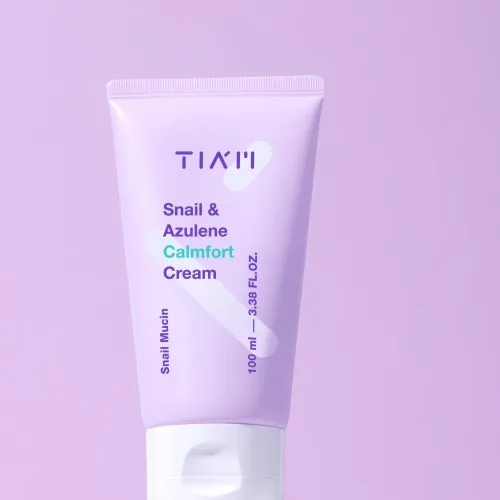
TIAM
Snail & Azulene Cream
100ml
Test a new cream on the same spot on your inner arm twice a day for 7–10 days. Follow the pack’s directions when applying it to your face.
View on NaverWhat should you note down before you close the snail cream box?
Each line notes its source, so you can pull the list out unchanged when choosing your next snail cream.
- NameSnail Secretion Filtrate = a substance obtained by filtering the mucus of one or more snail species · Snail Extract is a different ingredient, from the body (KCIA Cosmetic Ingredient Dictionary)
- PositionListed from the largest amount · ingredients at 1% or less in any order → don’t read percentages from the order (Enforcement Rule of the Cosmetics Act, Annex 4)
- MarkingNo snail-related name in the notified wrinkle-improvement ingredient list · the “functional cosmetic” words or symbol and efficacy section, Drug Safety Nara lookup (MFDS)
- Studies25 people, 12 weeks, one side of the face vs placebo (2013) · 50 people, 3 months, combined with egg extract, ingredient-company funding (2020)
- TestA quarter-sized spot on the inner arm · twice a day · 7–10 days · if redness, itching or swelling appears, wash off and stop (American Academy of Dermatology)
What are the common questions before bringing home a snail cream?
The ingredient obtained from mucus is listed as Snail Secretion Filtrate, the standard name in the KCIA Cosmetic Ingredient Dictionary. It is defined as a substance obtained by filtering the mucus of one or more snail species. There are other names from mucus too, such as Snail Mucous Vesicles and the ferment filtrates, while Snail Extract is a different ingredient extracted from the body. Check the exact name on the back ingredient list instead of just the word “snail” on the front.
Studies that applied a snail secretion ingredient include a 2013 study in which 25 people applied it to one side of the face for 12 weeks, and a 2020 study of 50 people over three months that used it with egg extract. The first reported improvement in eye-area wrinkle measurements, but participants themselves reported no significant difference in skin quality; in the second, the control group’s fine lines also improved, and the ingredient company funded the study. Under the MFDS guideline, a product that has not gone through functional cosmetic review (or reporting) cannot claim wrinkle improvement on its label or in ads, so check the package for the words “functional cosmetic” and the efficacy section.
Annex 4 of Korea’s Enforcement Rule of the Cosmetics Act requires ingredients to be listed starting with the largest amount used, so near the front, you can read it as one of the ingredients used in larger amounts in that product. Ingredients used at 1% or less, however, can be listed in any order, and percentages aren’t written on the ingredient list. Don’t guess the exact amount from its position.
Dermatology reviews have written that mollusk-based products can cause allergic or irritant contact dermatitis on skin contact, and listed the need for allergy investigation among the limitations of snail mucin research. Other ingredients in the cream, such as preservatives, can also be the cause. So a newly opened cream goes on the inner arm twice a day for 7–10 days first, following the method of the American Academy of Dermatology (AAD). If it turns red, itchy or swollen, wash it off and don’t use it again.
The MFDS Guidelines on Cosmetic Labeling and Advertising (14 August 2025) give “skin regeneration, cell regeneration” and “promotes cell growth” as examples of prohibited expressions for cosmetics. “Removes or reduces scarring from wounds” and “treats or helps recover from abrasions and burns” are in the same tables. Don’t take such copy as a promise of an effect; check the package’s “functional cosmetic” marking, efficacy section and ingredient list to check.
Which name, position and marking should you check on the back of a snail cream?
On an ingredient list, Snail Secretion Filtrate is an ingredient obtained by filtering the mucus of one or more snail species, and it is a different name from Snail Extract, which comes from the body. Position on the list only shows the order of amount used; ingredients at 1% or less can sit in any order, so it doesn’t give you a percentage. Wrinkle improvement is checked through the “functional cosmetic” words or symbol and the efficacy section, and words like “regeneration” are read against the examples of prohibited expressions in the MFDS guideline. The snail ingredient studies involved 25 and 50 people, and one was funded by the ingredient company. A newly opened cream goes on the inner arm twice a day for 7–10 days first.
What to read next
- Propolis Skincare Labels: Ingredient Names and Contact Allergy
- Azulene Skincare Labels: Where the Blue Comes From and Reading “Soothing”
- AHA vs BHA vs PHA: Telling Them Apart by Ingredient Name and Label Cautions
- Serum vs Ampoule: What’s the Difference and Which Goes On First
- Browse all Glowmeo skincare guides


